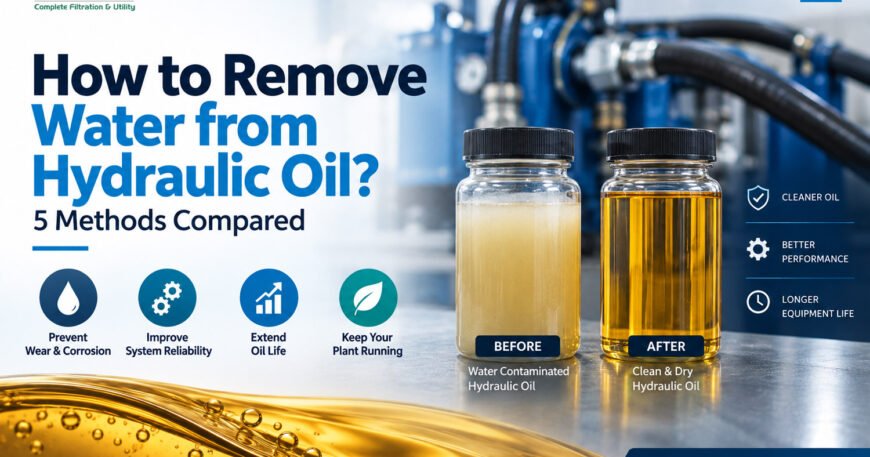
Hydraulic oil turning cloudy is never a good sign. Water has found its way into the system, and unless it is removed, it will corrode components, thin the lubricating film, and take out valves and pumps long before their time.
The good news is that water can be removed. The method you choose depends on how much water there is, what form it is in, and how clean the oil needs to end up. This guide compares the five main methods used in Indian plants, with the strengths and limits of each.
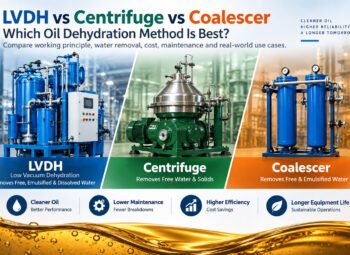
Quick answer: Free water can be drained or removed with a centrifuge or coalescer. Emulsified and dissolved water need vacuum dehydration (an LVDH machine), which is the only method that brings oil below its saturation point while also removing dissolved gases.
First, Confirm You Actually Have Water
Before choosing a method, confirm the problem and measure how bad it is.
| Check | What it shows | How quick |
|---|---|---|
| Visual inspection | Cloudy, hazy or milky oil usually means emulsified water | Instant |
| Crackle test | A drop of oil on a hotplate at about 130°C crackles or pops if water is present | 2 minutes |
| Tank bottom sample | Free water settles at the lowest point of the reservoir | 5 minutes |
| Karl Fischer test (lab) | Exact water content in ppm | 1–2 days |
| Online moisture sensor | Continuous reading of relative saturation | Live |
A lab report in ppm is the most useful, because it lets you compare your oil against the equipment maker’s limit and track whether your dehydration is working.
Understanding Saturation Point
Oil can hold a certain amount of water in dissolved form. That limit is the saturation point, and for many hydraulic oils it is only a few hundred ppm at working temperature. Below the limit, water stays invisible. Above it, it appears as haze and then as free water at the bottom of the tank.
This matters because some methods only remove what is above the saturation point. They cannot touch the dissolved water below it, yet dissolved water still causes oxidation and additive loss. That is the difference between the first four methods and the fifth.
Method 1: Draining and Settling
The simplest approach. The reservoir stands still, water sinks below the oil, and the drain valve at the lowest point lets it out.
Best for: large amounts of free water, and as a first step before other treatment.
Advantages
- Costs nothing and needs no equipment
- Removes bulk water quickly
Limits
- Only works on free water
- Needs the system to be idle so water can settle
- Does nothing for emulsified or dissolved water
- Additives in modern oils slow separation, so water may stay suspended for a long time
Method 2: Water-Absorbing Filter Elements
These cartridges hold a polymer that swells as it absorbs water, and they fit into standard filter housings.
Best for: small systems with low water ingress, and as a final polishing stage.
Advantages
- Easy to fit into existing filter housings
- Low initial cost
- Removes particles at the same time
Limits
- Very limited capacity, since each element holds only a small quantity of water
- Elements need frequent replacement, which becomes expensive
- Poor at handling dissolved water
- Once saturated, an element stops working and can restrict flow
Method 3: Coalescing Separators
A coalescer merges fine water droplets into larger ones that separate under gravity and collect in a sump.
Best for: fuels and low-additive oils with a steady flow of free and emulsified water.
Advantages
- Continuous operation with no consumable absorbents
- Handles free water well, plus some emulsified water
- Low running cost
Limits
- Cannot remove dissolved water
- Surfactants and additives in hydraulic oils reduce its effectiveness
- Coalescer elements clog and need replacing
- Does not remove dissolved gases
Method 4: Centrifuges
A centrifuge spins the oil at high speed, and because water is denser than oil, it is thrown outward and separated.
Best for: large volumes of free water, such as after a cooler failure or flooding.
Advantages
- High throughput of free water
- No consumable filter elements
- Handles heavily contaminated oil
Limits
- Cannot remove dissolved water
- Struggles with stable emulsions
- Higher speeds can introduce air into the oil, encouraging oxidation
- Higher capital cost and more maintenance
- Does not remove dissolved gases
Method 5: Vacuum Dehydration (LVDH Machine)
A low vacuum dehydration machine heats the oil gently, then exposes it as a thin film to vacuum. Because lower pressure lowers the boiling point of water, moisture evaporates at a temperature that is safe for the oil. The vapour is condensed and drained, and the dry oil passes through a fine filter on its way back to the reservoir.
Best for: systems that must reach and stay below the saturation point, and anywhere water ingress is continuous.
Advantages
- Removes free, emulsified and dissolved water
- Removes entrained air and dissolved gases
- Runs at a low temperature, so the oil and its additives are protected
- Works offline in a loop, so equipment keeps running
- Includes fine filtration for particles
- Automatic operation with minimal manpower
Limits
- Higher initial cost than absorbent elements
- Needs power and a small amount of floor space
- Removing large volumes of water takes multiple passes
For a full explanation of the process, read our guide: What Is an LVDH Machine?
Side-by-Side Comparison
| Method | Free water | Emulsified water | Dissolved water | Gases | Oil-safe | Running cost |
|---|---|---|---|---|---|---|
| Draining / settling | ✔ | ✘ | ✘ | ✘ | ✔ | Nil |
| Absorbent elements | Small amounts | ✘ | ✘ | ✘ | ✔ | High (consumables) |
| Coalescer | ✔ | Partial | ✘ | ✘ | ✔ | Low |
| Centrifuge | ✔ | Partial | ✘ | ✘ | Risk of aeration | Medium |
| Vacuum dehydration (LVDH) | ✔ | ✔ | ✔ | ✔ | ✔ | Low |
Which Method Should You Choose?
- A cooler has burst and the tank is full of water: drain the free water first, then run an LVDH machine to clear what remains.
- Oil is cloudy and analysis shows high ppm: vacuum dehydration, since the water is emulsified and dissolved.
- A small reservoir with occasional moisture: absorbent elements may be enough.
- Constant water ingress in a humid plant: a permanently installed LVDH machine.
- Turbine or servo systems with tight cleanliness limits: vacuum dehydration, because these systems need water well below saturation.
Stop the Water Getting In
Removing water treats the symptom. Also fix the cause:
- Fit desiccant breathers on reservoirs so humid air doesn’t enter
- Repair leaking heat exchangers and coolers, a very common source
- Replace worn cylinder rod seals and tank gaskets
- Avoid pressure washing near breathers, filler caps and seals
- Store drums indoors and on their side, so water doesn’t collect on the lids
- Keep the oil above the dew point to reduce condensation inside tanks
- Test water content regularly so problems are caught early
Frequently Asked Questions
How much water is too much in hydraulic oil?
It depends on the oil and the equipment maker’s specification, but many industrial systems aim to stay below the oil’s saturation point, and turbine and servo systems require even less. Check your OEM manual and oil analysis report for the exact limit.
Can I remove water from hydraulic oil by heating it?
Not safely. Heating oil to the boiling point of water at atmospheric pressure damages the base oil and its additives. Vacuum dehydration solves this by lowering the boiling point so water evaporates at 44–60°C.
Does a normal filter remove water?
No. Standard particulate filters remove solids only. Water-absorbing elements remove a small quantity of water, but they cannot handle dissolved water or continuous ingress.
Is cloudy oil always caused by water?
Cloudiness usually points to emulsified water, but air entrainment can look similar. A crackle test or lab analysis will confirm it.
Can water be removed while the machine is running?
Yes. An LVDH machine connects to the reservoir as an offline loop, so no shutdown is needed.
What happens if water is left in hydraulic oil?
Expect corrosion, faster additive depletion, sludge and varnish, sticking valves, reduced bearing life and more frequent oil changes.
Conclusion
Draining, absorbent elements, coalescers and centrifuges all have a place, but they share one limit: none of them removes dissolved water. Vacuum dehydration does, along with emulsified water and dissolved gases, and it does so without damaging the oil.
Need help choosing? See CFAU’s Low Vacuum Dehydration Machines (LVDH), available in five models from LVDH 600 to LVDH 6000, or talk to our engineers with your oil type, reservoir volume and water content.