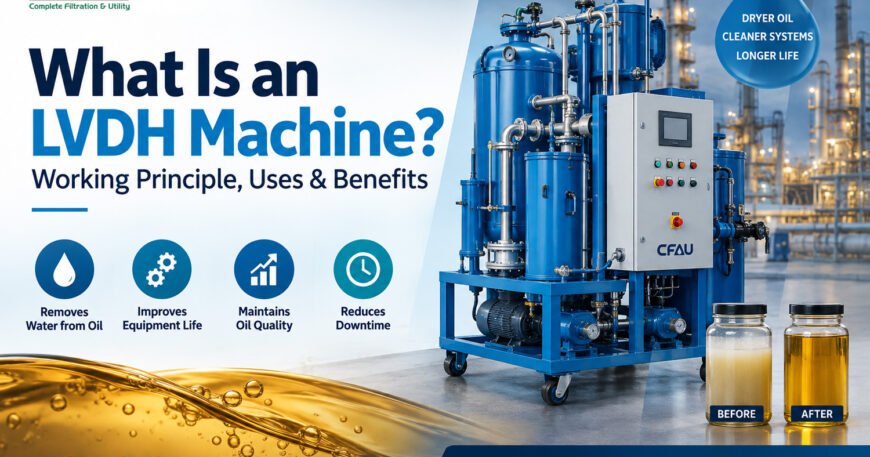
Water is one of the most damaging contaminants in hydraulic and lubricating oil. It is often invisible, it builds up slowly, and by the time a valve sticks or a bearing fails, the damage is already done. An LVDH machine is one of the most effective ways to remove that water and keep oil in working condition.
This guide explains what an LVDH machine is, how it works, what it removes, and when your plant might need one.
Quick answer: An LVDH (Low Vacuum Dehydration) machine is an offline oil purification unit that removes free, emulsified and dissolved water, plus air and gases, from industrial oils. It heats the oil gently and exposes it to vacuum, so water evaporates at a low temperature without damaging the oil.
What Does LVDH Stand For?
LVDH stands for Low Vacuum Dehydration. The name describes the method:
- Low vacuum: the machine lowers the pressure inside a chamber.
- Dehydration: it removes water from the oil.
You may also see these machines called a low vacuum dehydration unit, vacuum dehydrator, oil dehydration system or vacuum oil purifier. They all refer to the same basic technology.
Why Water in Oil Is a Problem
Every oil can hold a small amount of water in dissolved form. This limit is called the saturation point, and for many hydraulic and lube oils it is only a few hundred ppm (parts per million) at normal operating temperature. Once water goes beyond that limit, it starts causing trouble:
- Rust and corrosion on pumps, cylinders, valves and bearings
- A weaker lubricating film, which increases wear
- Faster oxidation of the oil and loss of additives
- Sludge and varnish that clog filters and make valves stick
- Shorter bearing life and more unplanned shutdowns
Water gets into oil through humid air, leaking heat exchangers and coolers, damaged seals, washdown, condensation in tanks, and process contamination. In steel plants, paper mills and power plants, it is a constant battle.
The Three Forms of Water in Oil
To understand why an LVDH machine is so useful, you need to know that water exists in oil in three different forms:
| Form | What it looks like | Easy to remove? |
|---|---|---|
| Free water | Separate droplets or a layer at the bottom of the tank | Yes, it can settle or be drained |
| Emulsified water | Fine droplets suspended in oil, making it cloudy or milky | Difficult |
| Dissolved water | Invisible, held at the molecular level | Very difficult |
Drain valves and settling tanks handle only free water. Emulsified and dissolved water need a different approach, and that is where low vacuum dehydration comes in.
How Does an LVDH Machine Work?
The science: lower pressure, lower boiling point
At normal atmospheric pressure, water boils at 100°C. Heating oil to that temperature would damage it, breaking down the base oil and its additives.
But the boiling point of water drops as pressure drops. At roughly one-tenth of atmospheric pressure, water boils at around 46°C. An LVDH machine uses this principle. By creating a vacuum, it makes water evaporate at a temperature that is safe for the oil. CFAU’s LVDH machines, for example, operate at just 44–60°C.
Step-by-step working principle
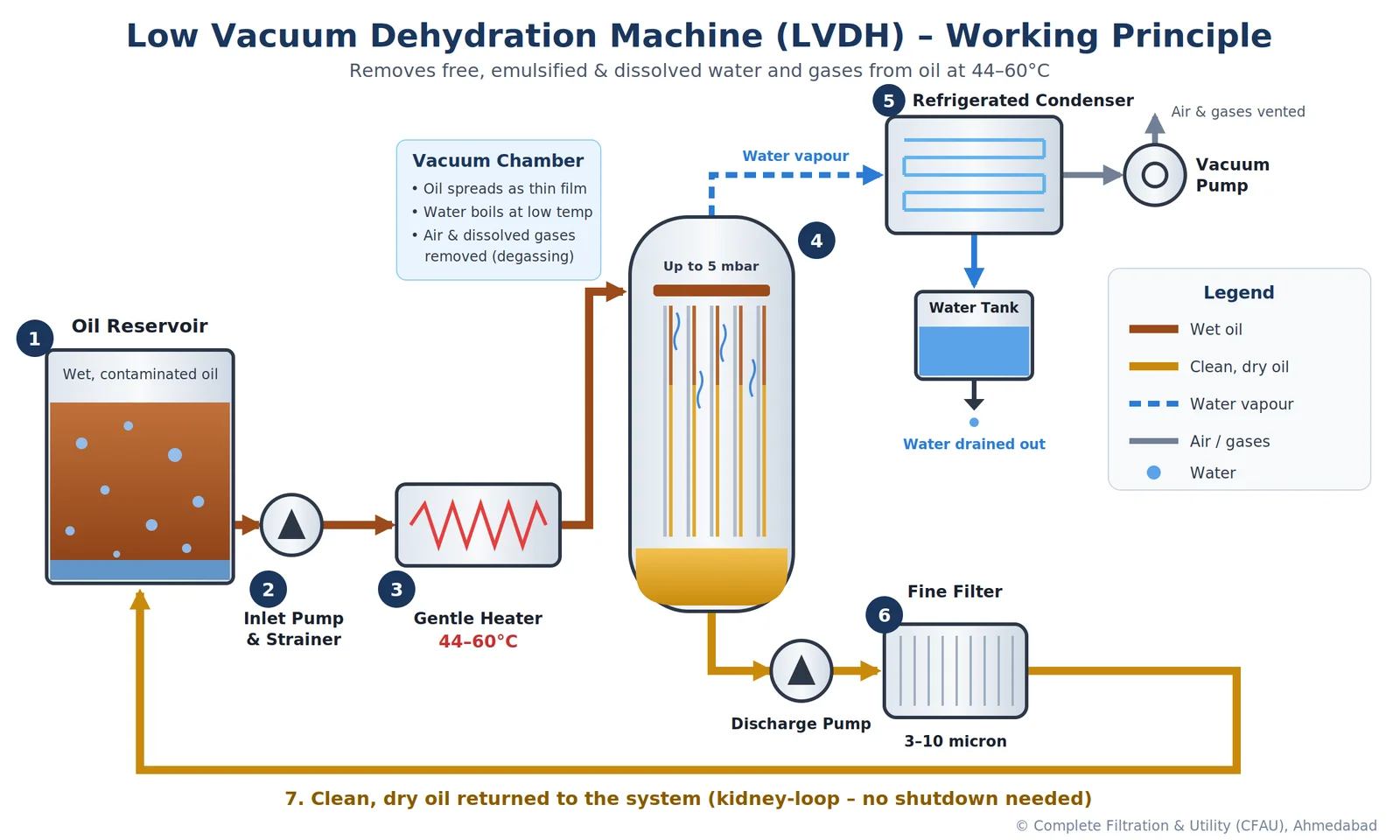
- Oil intake: wet oil is drawn from the reservoir through a strainer that catches large particles.
- Gentle heating: a heater warms the oil to a low, controlled temperature.
- Vacuum chamber: the warm oil enters a chamber under vacuum and spreads into a thin film. The thin film gives water the largest possible surface to evaporate from.
- Evaporation and degassing: water turns into vapour, and dissolved air and gases are pulled out of the oil at the same time.
- Condensation: the vapour passes to a condenser, turns back into liquid water, and collects in a tank for draining. The vacuum pump releases air and gases.
- Fine filtration: the dry oil is pumped through a fine filter to remove solid particles.
- Return: clean, dry oil flows back to the reservoir.
Because the machine works in a loop connected to the reservoir, it can run while the equipment is operating. Each pass removes more water until the oil reaches the target level.
Main components of an LVDH machine
- Inlet pump and suction strainer
- Heater with temperature control
- Vacuum chamber (the dehydration column)
- Vacuum pump
- Condenser and water collection tank
- Discharge pump
- Fine filter housing
- Control panel with safety interlocks and level sensors
What an LVDH Machine Removes (and What It Doesn’t)
An LVDH machine removes:
- Free water
- Emulsified water
- Dissolved water, bringing it well below the oil’s saturation point
- Entrained air and dissolved gases
- Solid particles, through its fine filter
An LVDH machine does not:
- Replace additives that have already been used up
- Reverse heavy oxidation in oil that is at the end of its life
- Fix the source of water ingress, such as a leaking cooler or worn seal
For best results, use an LVDH machine alongside regular oil analysis and fix the root cause of water entry.
Where Are LVDH Machines Used?
Oils treated
- Hydraulic oils
- Turbine oils
- Compressor oils
- Vacuum pump and compressor seal oils
- Gear oils
- Oils that need dehydrating before blending
Industries
- Steel plants: rolling mill hydraulics exposed to cooling water
- Power plants: turbine lube and control oil systems
- Paper mills: humid conditions with constant water ingress
- Cement plants: gearboxes and hydraulics
- Plastic and injection moulding: hydraulic presses
- Sugar mills: mill drives and lubrication systems
- Oil & gas and chemical plants: compressors and seal oil systems
LVDH vs Other Water Removal Methods
| Method | Free water | Emulsified water | Dissolved water | Gases |
|---|---|---|---|---|
| LVDH | ✔ | ✔ | ✔ | ✔ |
| Centrifuge | ✔ | Partial | ✘ | ✘ |
| Coalescer | ✔ | Partial | ✘ | ✘ |
| Water-absorbing filter elements | Small amounts | ✘ | ✘ | ✘ |
Centrifuges and coalescers work well for large amounts of free water, but they cannot bring oil below its saturation point. Only vacuum dehydration removes all three forms of water and dissolved gases in one machine.
Benefits of Using an LVDH Machine
- Longer oil life: less frequent oil changes and lower disposal costs.
- Longer equipment life: less corrosion and wear on pumps, valves, bearings and gears.
- Fewer breakdowns: fewer sticking valves and unplanned stoppages.
- No damage to oil: low-temperature operation protects the oil and its additives.
- No downtime: the machine runs while your equipment keeps working.
- Lower environmental impact: less waste oil to dispose of.
Signs Your Plant Needs an LVDH Machine
Consider an LVDH machine if you notice any of these:
- Oil looks cloudy, hazy or milky
- A crackle test (heating a drop of oil on a hot plate) produces popping sounds
- Oil analysis shows water content above your equipment maker’s limit
- Water collects at the bottom of reservoirs
- Valves stick or servo valves fail repeatedly
- Rust appears inside tanks or on components
- Oil needs changing much sooner than expected
- Equipment runs in a humid area or near water-cooled systems
How to Choose the Right LVDH Machine
When selecting a machine, share these details with your supplier:
- Oil type and viscosity grade (for example, ISO VG 46 or VG 320)
- Reservoir volume in litres
- Current water content from an oil analysis report, if available
- Target water content required by your equipment maker
- Source and rate of water ingress
- Site conditions: power supply, space, and whether the machine needs to move between reservoirs
These details decide the flow rate, heater size and model that suit your application.
Frequently Asked Questions
What is an LVDH machine used for?
It removes free, emulsified and dissolved water, as well as air and gases, from industrial oils such as hydraulic, turbine, compressor and gear oils.
What is the working principle of an LVDH machine?
It lowers the pressure inside a chamber so water boils at a low temperature. The oil is gently heated, spread into a thin film under vacuum, and the water evaporates and is condensed and drained away.
Does an LVDH machine damage the oil?
No. Because water evaporates at low temperature under vacuum, the oil is heated only mildly, which protects the base oil and additives.
Can an LVDH machine run while the equipment is working?
Yes. It runs as an offline loop connected to the reservoir, so the equipment does not need to stop.
Is an LVDH machine better than a centrifuge?
For removing dissolved water and gases, yes. A centrifuge removes free water and some emulsified water but cannot bring oil below its saturation point.
How long does an LVDH machine take to dry oil?
It depends on the reservoir size, starting water content, oil viscosity and machine flow rate. Larger or wetter systems need more passes.
Conclusion
An LVDH machine tackles one of the biggest causes of hydraulic and lubrication failures: water. By using vacuum to lower the boiling point, it removes all three forms of water and dissolved gases at a low, oil-safe temperature, without stopping your equipment. The result is cleaner oil, longer equipment life and fewer breakdowns.
Looking for the right machine for your plant? Explore CFAU’s range of Low Vacuum Dehydration Machines (LVDH), with five models from LVDH 600 to LVDH 6000, or contact our team for a recommendation.