“A little water in the oil” is one of the most underestimated problems in industrial maintenance. It doesn’t announce itself with noise or vibration. It works quietly, through chemistry, until a valve sticks, a bearing pits, or a turbine trips on a low insulation resistance alarm. By then, the water has usually been there for weeks or months.
This post explains exactly what water does to oil and equipment, what water content is considered safe for different oil types, and how to test for it accurately, so you can catch the problem before it becomes a failure.
Quick answer: Water damages oil through corrosion, additive breakdown and loss of lubricating film, and damages equipment through pitting, micro-dieseling and insulation failure. Most hydraulic and turbine oils should be kept below 50% of their saturation point, which is often a few hundred ppm, though exact limits vary by oil and equipment type. Testing ranges from a quick field crackle test to a precise lab-based Karl Fischer titration.
How Water Actually Damages Oil
Water doesn’t just sit inertly in oil. It drives several chemical and mechanical processes that degrade both the oil and the machine it lubricates.
1. Corrosion and rust
Water reacts directly with iron and steel surfaces to form rust. Rust particles are abrasive and accelerate wear everywhere they circulate, and corroded surfaces on bearings, gears and cylinder walls create stress points that lead to fatigue failure.
2. Additive depletion
Modern hydraulic and turbine oils rely on additive packages, anti-wear agents, rust inhibitors, antioxidants, to do their job. Water reacts with many of these additives, consuming them faster than normal. Once additives are depleted, the base oil is left to protect the system on its own, which it generally cannot do for long.
3. Hydrolysis
Some oils, particularly certain synthetic esters and some anti-wear additives, are chemically broken down by water in a reaction called hydrolysis. This produces acidic byproducts, which then accelerate corrosion and further oil degradation, a self-reinforcing cycle.
4. Loss of lubricating film
Water doesn’t lubricate. Where water displaces oil at a metal-to-metal contact point, even briefly, the protective film thins or fails, increasing friction and wear. In severe cases, this leads directly to scoring and surface damage.
5. Micro-dieseling
In high-pressure hydraulic systems, entrained water and air bubbles can collapse violently under pressure, generating intense, localized heat, enough to burn (or “diesel”) the surrounding oil. This produces soot, varnish and further additive breakdown, and happens at a scale invisible to the naked eye.
6. Reduced dielectric strength (critical for turbine and transformer-adjacent oils)
For oils in systems with electrical considerations, such as turbine lube/control oil near generators, water sharply reduces dielectric strength (the oil’s ability to resist electrical breakdown). This is tested separately from, but closely tied to, water content.
7. Sludge and varnish
Oxidation products, accelerated by water, don’t always stay dissolved in the oil. They can precipitate out as sludge and varnish, which coat valve spools, restrict orifices, and cause sticking, especially in sensitive servo and proportional valves.
Safe Water Content: Understanding ppm Limits
The saturation point is the real reference, not a single fixed number
There is no single “safe ppm” figure true for every oil. The right reference point is the oil’s saturation point, the amount of water the oil can hold in fully dissolved form at a given temperature, before it starts to appear as haze or free water. Saturation point varies significantly by oil type, additive package, and oil age:
- Newer, more refined oils with fewer polar additives tend to have lower saturation points (water becomes visible sooner).
- Oils with certain additive packages, and more degraded/oxidized oils, often have higher saturation points (water can hide longer before becoming visible), which is actually a higher risk, since haze is no longer a reliable early warning sign.
This is why oil analysis labs typically report water content in ppm and the oil’s percentage of saturation, since the percentage is what actually indicates risk.
General guidance by oil type
The figures below are widely used industry starting points, not universal standards. Always check your equipment manufacturer’s specification first, since it overrides general guidance.
| Oil type / system | Commonly cited guidance |
|---|---|
| General industrial hydraulic oil | Keep below 50% of saturation; many plants target under a few hundred ppm depending on oil |
| Turbine lube/control oil | Typically much stricter, often targeted below 100–200 ppm or per OEM/ISO guidance, due to dielectric and varnish sensitivity |
| Gear oil | Varies by application; marine and heavy industrial gear oils often tolerate somewhat more than precision hydraulic systems |
| Compressor oil | Depends on compressor type; rotary screw compressors are typically sensitive to both water and particulate contamination |
| EHC (electro-hydraulic control) fluids | Very tight limits, since these systems combine hydraulic and electrical sensitivity |
Always confirm the exact figure with:
- Your equipment OEM’s maintenance manual
- The oil manufacturer’s technical data sheet
- Relevant standards your industry follows (for example, ISO, ASTM or OEM-specific guidance for turbine oils)
How to Test Water Content in Oil
1. Visual inspection
What it shows: Haze or cloudiness generally indicates water above the saturation point (free or emulsified water present). Limits: Oil can contain significant dissolved water below saturation and still look perfectly clear. A clear sample does not mean a dry sample.
2. Crackle test
How it works: A few drops of oil are placed on a hotplate heated to around 130°C. If water is present, it boils rapidly and produces an audible crackling or popping sound as it escapes through the oil. What it shows: A quick, low-cost field indication of free or emulsified water. Limits: It’s qualitative, not quantitative. It won’t reliably detect water below roughly 500–1000 ppm (varies by technique and operator), and it can’t distinguish 600 ppm from 6,000 ppm. Useful as a fast screening tool, not for precise monitoring.
3. Karl Fischer titration (the laboratory standard)
How it works: A chemical titration method (commonly following ASTM D6304) that reacts water in the oil sample with a reagent in a precise, measurable way, giving an exact water content in ppm. What it shows: The most accurate, quantitative water content measurement available, and the method oil analysis labs use for trending. Limits: Requires sending a sample to a lab (or an on-site Karl Fischer titrator), so results aren’t instant.
4. Dielectric breakdown voltage test
How it works: Measures the voltage at which the oil’s insulating properties fail. Water sharply reduces this value. What it shows: Particularly relevant for turbine and transformer-adjacent oils, since it reflects both water content and overall oil condition. Limits: An indirect indicator; it doesn’t give an exact ppm figure on its own.
5. Online/continuous moisture sensors
How it works: A probe installed directly in the system continuously measures relative saturation (and sometimes temperature-compensated ppm) and can feed data to a control system or trigger alarms. What it shows: Real-time, continuous monitoring, which is valuable for critical or hard-to-sample systems. Limits: Higher upfront cost than periodic lab sampling; sensors need periodic calibration/verification against lab results.
Choosing a testing approach
| Situation | Recommended approach |
|---|---|
| Routine monitoring, non-critical system | Scheduled lab sampling (Karl Fischer) every 1–3 months |
| Critical system (turbine, servo, EHC) | Combination of scheduled lab testing plus online sensors |
| Suspected contamination event | Immediate crackle test for a fast read, followed by lab confirmation |
| Verifying dehydration treatment worked | Lab testing (Karl Fischer) before and after treatment, for an accurate before/after ppm comparison |
Building a Simple Water Monitoring Program
- Baseline: Test all critical reservoirs now, even if there’s no known problem, to establish where you stand.
- Set targets: Confirm the acceptable ppm/saturation limit for each oil type and system from OEM documentation.
- Schedule testing: Monthly or quarterly lab sampling for most systems; continuous sensors for the most critical ones.
- Track trends, not just single readings: A steady upward trend often reveals a developing seal or cooler leak before it becomes severe.
- Act on findings: When results approach your target limit, treat the oil (see our guide on removing water from hydraulic oil) and investigate the source of ingress.
- Verify after treatment: Re-test after dehydration to confirm the target ppm was actually reached, not just that the oil looks clearer.
FAQ’s
What ppm of water is dangerous in hydraulic oil?
It depends on the specific oil’s saturation point and your equipment’s sensitivity, so there’s no single universal number. As a general principle, staying below 50% of the oil’s saturation point is a common target, with turbine and precision servo systems typically requiring stricter limits. Always confirm with your OEM and oil supplier’s documentation.
Can water in oil cause immediate equipment failure?
It can, particularly through micro-dieseling in high-pressure systems or sudden valve sticking from sludge, but more often water damage accumulates gradually through corrosion and additive depletion until a failure occurs.
What’s the difference between the crackle test and a Karl Fischer test?
The crackle test is a fast, free, qualitative field check that tells you water is present above a rough threshold. Karl Fischer titration is a precise laboratory method that gives an exact ppm figure, suitable for trending and verifying treatment results.
How often should I test my hydraulic oil for water?
For most industrial systems, monthly to quarterly lab testing is a reasonable starting point, with more frequent or continuous monitoring for critical or high-risk systems. Adjust based on your history of contamination events.
Does a lower ppm always mean safer oil?
Generally yes, but the percentage of saturation matters more than the raw ppm number alone, since the same ppm figure can represent very different risk levels depending on the specific oil’s saturation point.
How do I bring water content back down once it’s too high?
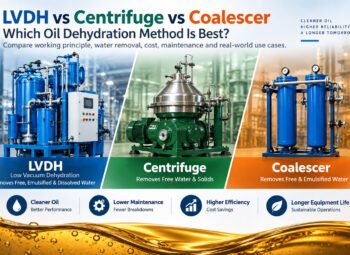
Lab testing will confirm the current ppm. From there, options range from settling and centrifuging for free water to vacuum dehydration (LVDH) for emulsified and dissolved water. See our comparison of LVDH vs centrifuge vs coalescer to choose the right method.
Conclusion
Water in oil causes damage long before it’s visible, through corrosion, additive breakdown, hydrolysis and micro-dieseling. Because safe limits vary by oil type and system, the right approach is to confirm your equipment’s specific target, test regularly using the right method for your criticality level, and treat the oil before water content becomes a reliability risk rather than after.
Need to bring your oil’s water content back under control? Explore CFAU’s Low Vacuum Dehydration Machines (LVDH), available in five models from LVDH 600 to LVDH 6000, or contact our engineers with your latest oil analysis report.