Choosing a filter for industrial water usually starts with a simple question: what exactly are we trying to remove? Sand from a borewell is a very different problem from fine silt in a cooling tower or rust flakes in a closed loop. Pick the wrong technology and you end up cleaning screens every shift or replacing cartridges every week.
In this article we compare four of the most common options for solids removal: the vortex separator, the sand (media) filter, the screen strainer and the cartridge or bag filter. We look at how each one works, what it does well, where it struggles, and what it really costs to run. If you are new to vortex filters, our guide on what a vortex filtration system is and how it works is a good place to start.
Quick Comparison Table
| Feature | Vortex separator | Sand / media filter | Screen strainer | Cartridge / bag filter |
|---|---|---|---|---|
| Removal principle | Centrifugal force | Depth filtration in media | Mesh screen | Surface or depth media |
| Best for | Heavy solids such as sand, grit, scale | Fine suspended solids and turbidity | Large debris | Fine polishing |
| Consumables | None | Media top up or replacement | Occasional screen | Frequent replacement |
| Backwash or cleaning | Short purge only | Regular backwash | Manual or automatic cleaning | Change elements |
| Pressure drop | Low and constant | Rises as it loads | Rises as it clogs | Rises as it clogs |
| Water loss | Very low | Moderate to high | Low | None, but waste elements |
| Footprint | Compact | Large | Very compact | Compact |
Vortex Separator
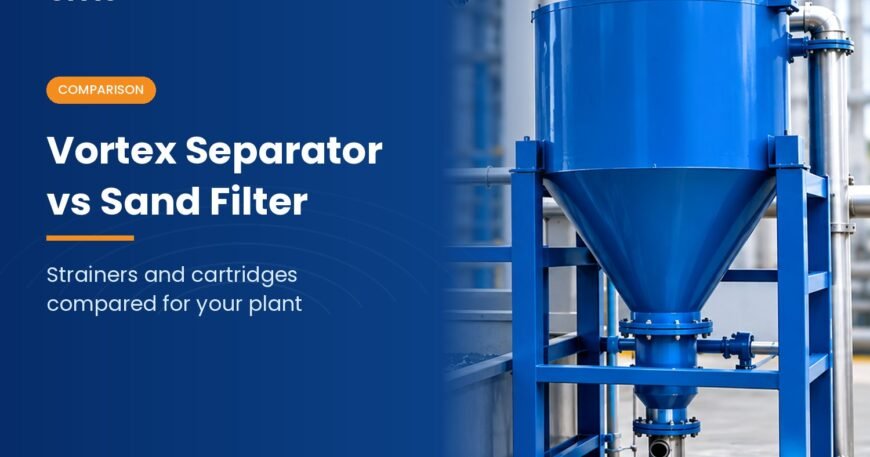
A vortex separator spins the water so that heavy particles move to the outer wall and settle into a collection chamber, while clean water leaves from the top. There is no screen to block and no media to replace.
Where it shines: water carrying sand, grit, scale and metal fines. It is a strong choice as an industrial particle removal system on borewell lines, cooling tower side streams and recirculating process water.
Where it struggles: light particles close to the density of water, such as algae or organic flocs, and anything dissolved. It also needs a reasonably steady flow to keep the vortex strong.
Sand or Multimedia Filter
A sand filter pushes water through a deep bed of graded sand or multimedia. Particles are trapped as the water travels through the bed. These filters can achieve finer filtration than a vortex separator and handle light particles better.
The trade off is maintenance and water. As the bed fills, pressure drop rises and the filter must be backwashed. Backwashing uses a noticeable volume of clean water and creates a waste stream you then have to manage. Heavy sand loads also shorten the time between backwashes, which is why many plants place a vortex separator in front of a media filter.
Screen Strainer
Y strainers and basket strainers are cheap and simple. They are great for catching large debris such as weld slag, gasket pieces or leaves. The problem is that the finer the mesh, the faster it blocks. On dirty water, someone ends up opening and cleaning the basket very often. Automatic self cleaning filters solve this by cleaning the screen on their own, and they pair well with a vortex separator for fine screening after bulk solids removal.
Cartridge and Bag Filters
Cartridge and bag filters give precise, fine filtration and are often used for final polishing before membranes or sensitive equipment. They are a poor choice for heavy solids, though. Sand and grit load them up very quickly, and the running cost of replacement elements adds up fast. Used after a vortex filter, their life can be extended many times over.
So Which One Should You Choose?
In practice, the answer is often not one filter but the right combination. Here is a simple rule of thumb we use when advising customers:
- Mostly heavy solids (sand, grit, scale): start with a vortex separator.
- Fine turbidity or light suspended solids: use a media filter or a self cleaning screen filter, ideally with a vortex separator ahead of it if sand is present.
- Large debris only: a strainer may be enough.
- Final polishing before RO or sensitive equipment: cartridge filters, protected by upstream filtration.
A Real World Example
Consider a typical plant drawing borewell water with visible sand. Their cartridge filters ahead of the softener were being replaced every few days. Adding a vortex separator as the first stage takes most of the sand out before it ever reaches the cartridges. The cartridges then last far longer, the softener resin stays cleaner, and the maintenance team spends its time on other work. This kind of layout is a common, sensible design for an industrial water filtration system.
Cost of Ownership, Not Just Purchase Price
When comparing quotes, look beyond the price of the equipment. Add up the cost of replacement media or cartridges, the water lost to backwashing, the labour spent cleaning, the energy used to overcome pressure drop, and the cost of damage to pumps and heat exchangers. On sandy water, the vortex separator usually comes out well ahead over the life of the plant because it has almost no running cost.
Frequently Asked Questions
Can a vortex separator replace a sand filter completely?
Sometimes, but not always. If your main problem is heavy solids, a vortex separator may be all you need. If you also need low turbidity, keep a finer filter after it.
Is a vortex separator suitable for wastewater?
Yes, for removing grit and heavy solids in a wastewater filtration system. For full treatment you would still need a complete wastewater treatment plant.
Conclusion
Every filter type has its place. The key is to match the technology to the particles you actually have. For heavy, abrasive solids, a vortex separator is usually the most economical first step, and it makes every filter after it work better.
Want help choosing? Explore our Vortex Filtration System or contact CFAU with your flow rate and a description of your water, and our team will recommend the right combination.