If you have ever opened a heat exchanger and found it packed with sand, or replaced the same set of cartridge filters every few days, you already know the problem a vortex filtration system is built to solve. Suspended solids in industrial water are rarely dramatic. They just keep wearing things out, blocking things up and quietly adding to your maintenance bill.
In this guide we explain what a vortex filtration system is, how it works, the two main types you will come across, and where it makes the most sense in a plant. If you are short on time, the quick answer is this: a vortex filter uses the spin of the water itself to throw heavy particles out of the flow, so there is no filter media to clog and nothing to backwash.
What Is a Vortex Filtration System?
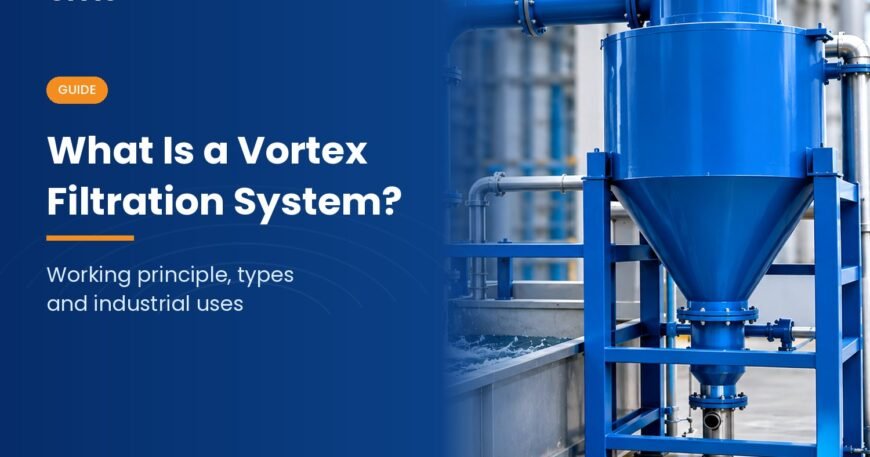
A vortex filtration system is a type of industrial solid liquid separation system that removes particles from water by making the water spin. You will also hear it called a vortex separator, a centrifugal separator or a sand separator. The names differ, but the idea is the same.
Water enters the vessel through a tangential inlet, which means it comes in along the side wall rather than straight into the centre. That sets up a fast rotating flow, a bit like water circling a drain. Heavy particles cannot follow the tight curve of that flow, so they are pushed outwards to the wall, slide down into a collection chamber and are flushed out from time to time. Clean water rises through the middle and leaves from the top.
Because separation happens through physics rather than through a screen or media bed, an industrial vortex filter does not get “full” in the way a cartridge or bag filter does. The pressure drop stays steady, day after day.
How Does a Vortex Filter Work? Step by Step
- Tangential entry: dirty water is pumped into the separator through an inlet set at an angle to the vessel wall.
- Spin and separation: the rotating flow creates centrifugal force. Particles heavier than water move to the outer wall.
- Downward spiral: along the wall, the solids travel down the conical section, helped by gravity.
- Quiet collection zone: at the bottom, the flow slows down and solids settle in a collection chamber.
- Clean water out: filtered water reverses direction, rises through the centre of the vortex and exits from the top outlet.
- Purge: a manual or automatic valve opens for a few seconds to flush the collected solids out, using very little water.
The whole process is continuous. You do not need to stop the line to clean the unit, which is one of the main reasons maintenance teams like it.
The Two Main Types of Vortex Filter
1. Centrifugal vortex separators for industrial water
This is the type most people mean when they talk about an industrial vortex filter. It has no screen at all. It is used on process water, cooling water, borewell water and wastewater lines to remove sand, grit, scale, metal fines and similar heavy solids. Separation performance depends on the density of the particles. Dense particles such as sand are removed very effectively, typically down to around 40 to 75 micron, while light organic matter that is close to the density of water will mostly pass through.
2. Screen type vortex filters for rainwater harvesting
The second type combines a swirling flow with a fine stainless steel sieve, often around 280 micron. Rainwater from the roof swirls around the screen. Clean water passes through to the storage tank, and leaves, twigs and grit are carried down and away to a drain. The swirling motion keeps washing the screen, so it is largely self cleaning. These units are sized by roof area rather than by flow rate in cubic metres per hour.
At CFAU we manufacture both. You can see the full range on our Vortex Filtration System page.
Where Is a Vortex Filtration System Used?
Vortex filters are most useful wherever water carries heavy solids and those solids cause wear, fouling or blockages downstream. Common applications include:
- Cooling towers: side stream filtration keeps airborne dust, sand and scale out of the basin and the heat exchangers.
- Process water filtration system lines: removing grit and debris from recirculating process water.
- Borewell and raw water: taking sand out before storage tanks, pumps and treatment plants.
- Protection of finer filters: reducing the load on cartridge filters, softeners, UF and RO systems.
- Wastewater filtration system duty: grit removal in effluent recycling lines.
- Machine coolant and wash water: taking out metal fines and abrasive particles.
- Rainwater harvesting: keeping roof debris out of storage tanks.
Benefits Compared with Conventional Filters
The appeal of a vortex filter comes down to a few practical points that plant engineers care about:
- No consumables. There are no cartridges, bags or media to buy and dispose of.
- No backwash. Media filters can use a surprising amount of water for backwashing. A vortex filter only loses a small volume during each purge.
- Steady pressure drop. Because nothing clogs, pumping energy stays predictable.
- No moving parts inside. There is very little to wear out in the separator itself.
- Compact footprint. A vortex separator usually takes much less floor space than a sand filter of similar flow.
A simple way to think about it: a vortex separator is not trying to catch every particle. It is designed to remove the heavy, abrasive solids that do most of the damage, cheaply and continuously.
Limitations You Should Know About
No filter does everything, and it is better to know the limits before you buy. A centrifugal vortex separator will not remove dissolved salts, colour or bacteria. It is also less effective on very fine or very light particles such as algae, oil droplets or fluffy organic matter. In those cases, the vortex filter works best as the first stage, followed by finer filtration or a self cleaning filter where needed. For dissolved solids, you would look at treatment options such as a reverse osmosis plant.
Flow rate also matters. Each separator is designed for a certain flow band. Running it far below that band reduces the spin and lowers efficiency, so correct sizing is important.
Frequently Asked Questions
Is a vortex filter the same as a hydrocyclone?
They work on the same centrifugal principle. In everyday use, “hydrocyclone” is more common in mining and slurry duty, while “vortex separator” or “vortex filter” is the usual term for water filtration in utilities and process plants.
How often does a vortex filter need to be purged?
It depends on how much solid material is in the water. Some sites purge once a day, while dirty borewell or cooling tower water may need purging every few hours. An automatic purge valve with a timer takes care of this without operator involvement.
Does a vortex filtration system need electricity?
The separator itself does not. Power is only needed for an automatic purge valve and its controller, and of course for the pump that moves the water.
Final Thoughts
A vortex filtration system is one of the simplest ways to cut wear, fouling and filter replacement costs in an industrial water system. It will not replace every other filter, but as a first line of defence against sand, grit and scale it is hard to beat for cost and reliability.
Planning a new line or struggling with sand in an existing one? Take a look at the CFAU industrial vortex filter range or talk to our engineers. Share your flow rate and water source, and we will suggest the right size for your plant.