A cooling tower is, by design, a giant air scrubber. Every hour it pulls in huge volumes of air, and with that air comes dust, sand, pollen, leaves and anything else floating around the plant. All of it ends up in the cooling water. Add scale and corrosion products from the system itself, and you have a steady build up of solids that settles in the basin, fouls heat exchangers and blocks spray nozzles.
Side stream vortex filtration is one of the most cost effective ways to keep that dirt under control. In this post we explain how it works, how to size it, and what kind of results you can realistically expect.
Why Cooling Water Gets Dirty So Quickly
Cooling towers concentrate whatever comes in. As water evaporates, the solids stay behind. Typical sources of suspended solids include:
- Airborne dust and sand, especially near roads, construction or open land
- Silt and grit in the makeup water
- Scale particles and corrosion products from pipework
- Biological debris and leaves
These solids create sludge in the basin, give bacteria a place to grow, reduce the effectiveness of cooling water chemicals, and settle in low velocity areas of heat exchangers where they reduce heat transfer.
What Is Side Stream Filtration?
In full flow filtration, all the circulating water passes through the filter. That gives the most complete cleaning but needs a large, expensive filter and adds pressure drop to the main loop.
Side stream filtration takes a smaller portion of the circulating flow, filters it continuously and returns it to the basin. Over time, the whole volume of water passes through the filter many times a day. Because the filter is outside the main loop, it can be serviced without affecting cooling.
A vortex separator is well suited to this duty. It has no screen to clog, a low and constant pressure drop, and it purges the collected solids with very little water loss.
How a Side Stream Vortex Filter Is Installed
A typical layout looks like this:
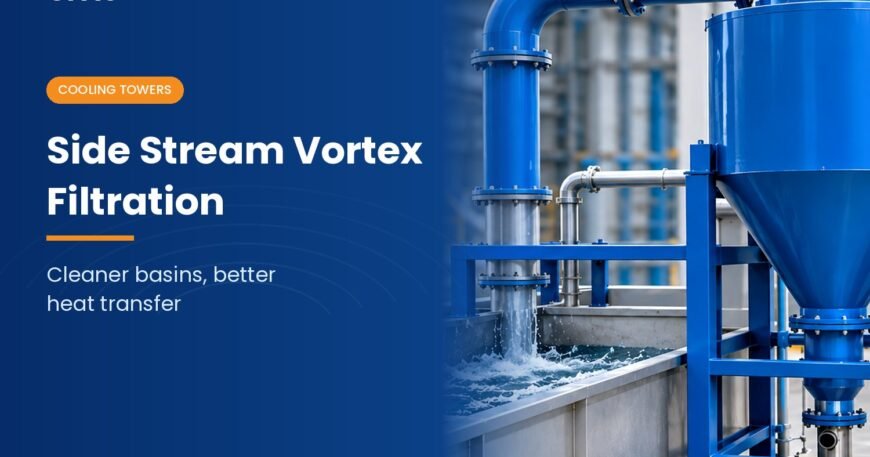
- A dedicated pump draws water from the cooling tower basin, often through a sweeper piping arrangement that picks up solids from the basin floor.
- The water passes through the vortex separator, where heavy solids are spun out.
- Clean water is returned to the basin or to the cold water line.
- Collected solids are purged to drain or to a small solids collection tank through an automatic valve.
Basin sweeping is worth mentioning. Without it, a lot of the sludge simply sits on the basin floor where the side stream intake never reaches it. A simple network of nozzles on the basin floor keeps solids moving towards the filter intake.
How Much Flow Should You Filter?
A common industry rule of thumb is to filter somewhere around 5 to 10 percent of the main circulating flow in a side stream loop. Dusty sites, open systems near construction, or plants with sensitive heat exchangers often go towards the higher end. Another way to look at it is basin turnover: many designers aim to pass the full basin volume through the filter several times an hour.
These figures are starting points, not rules. The right size depends on your system volume, the dust load in the area, and the quality of your makeup water. At CFAU we size each vortex filtration system to the actual site conditions.
Benefits You Can Expect
- Cleaner basins: less sludge and fewer manual basin cleanings.
- Better heat transfer: less fouling in condensers and heat exchangers means better approach temperatures.
- More effective chemical treatment: biocides and inhibitors work better in clean water with fewer solids to hide bacteria.
- Fewer blocked nozzles: spray distribution stays even across the fill.
- Lower water loss than backwash filters: a vortex filter purges only a small volume, which matters on sites where water is expensive or scarce.
- Less wear on pumps and valves from abrasive sand.
What a Vortex Filter Will Not Do
It is worth being honest about the limits. A vortex separator removes particles that are heavier than water. It will not remove dissolved salts, and it is less effective on very fine silt or light biological matter. If your cooling water has a lot of fine silt, you may want a screen based self cleaning filter after the vortex separator. Water chemistry still needs a proper treatment programme.
Practical Tips from the Field
- Size the pump correctly. The vortex separator needs a reasonably steady flow within its design range to keep the spin strong.
- Use an automatic purge valve. Manual purging is often forgotten, and a full collection chamber stops working properly.
- Fit pressure gauges on the inlet and outlet so operators can see the unit is working normally.
- Check the basin after a few weeks of operation. You should see a clear drop in settled sludge.
Frequently Asked Questions
Can I add a side stream filter to an existing cooling tower?
Yes. Most side stream systems are retrofitted to existing towers. They usually need only a small pump, some piping back to the basin, a drain connection and a power point for the purge valve.
Is full flow filtration better than side stream?
Full flow gives the most thorough cleaning, but for most cooling towers side stream filtration gives most of the benefit at a much lower cost. It is the more common choice for industrial plants.
Conclusion
If your cooling tower basin needs regular cleaning, your heat exchangers foul faster than you would like, or your nozzles keep blocking, side stream vortex filtration is a practical, low maintenance fix. It works quietly in the background and keeps the water clean enough for everything else to do its job.
Read more about how a vortex separator compares with sand filters, strainers and cartridges, or explore the CFAU industrial vortex filter range. For a sizing recommendation, contact our team with your circulation flow and basin volume.