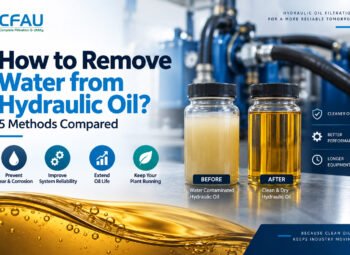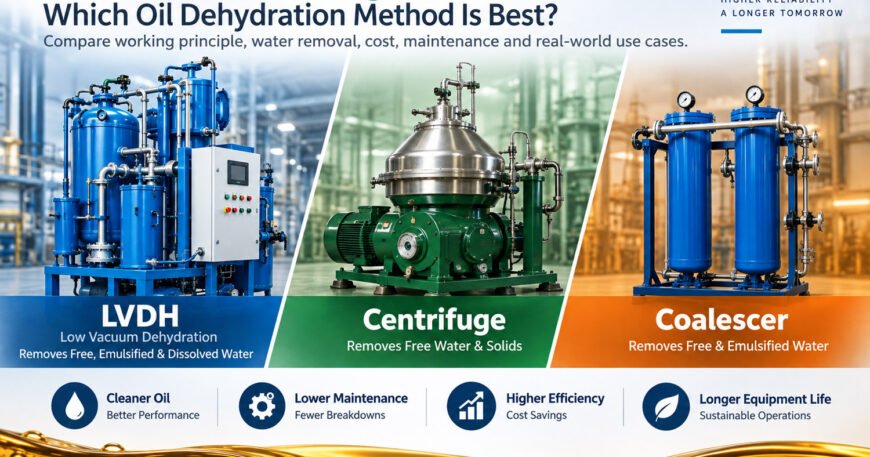
If your plant is choosing equipment to deal with water in oil, three technologies usually come up: low vacuum dehydration (LVDH), centrifuges, and coalescers. All three are established, all three are sold across India, and each has a genuine place. The right choice depends less on which is “best” overall and more on what your oil analysis shows and what your equipment can tolerate.
This post compares the three in depth, including cost, maintenance and the situations each one suits best.
Quick answer: Centrifuges and coalescers are best for high volumes of free water and solids. LVDH machines are the only option that also removes emulsified and dissolved water and dissolved gases, without heating the oil enough to damage it. If your oil analysis shows water near or above the saturation point, LVDH is the more reliable long-term choice.
How Each Technology Actually Works
Centrifuge
A centrifuge spins oil at high speed inside a rotating bowl. Because water is denser than oil, centrifugal force throws it to the outer wall, where it is separated and discharged, while lighter, cleaner oil moves toward the centre and out. Some centrifuges also remove solid particles the same way.
Coalescer
A coalescer passes oil through specially designed media (often pleated cellulose or fibreglass elements). As oil flows through, fine water droplets stick to the media and merge with other droplets, growing large enough to separate from the oil by gravity in a downstream sump or separator stage.
LVDH (Low Vacuum Dehydration)
An LVDH machine heats oil gently, typically to 44–60°C, then exposes it as a thin film inside a vacuum chamber. Because water boils at a much lower temperature under vacuum, moisture evaporates without the oil itself reaching a damaging temperature. The vapour condenses and drains away, dissolved gases are pulled out at the same time, and the dried oil passes through a fine filter before returning to the reservoir.
Head-to-Head: What Each Method Removes
| Contaminant | Centrifuge | Coalescer | LVDH |
|---|---|---|---|
| Free water | Yes, very effectively | Yes | Yes |
| Emulsified water | Partial, depends on droplet size | Partial, weakens with surfactant-heavy oils | Yes |
| Dissolved water | No | No | Yes |
| Entrained air / dissolved gases | No, can introduce air | No | Yes |
| Solid particles | Yes, as a byproduct | Only via a separate filter stage | Yes, via built-in fine filter |
This is the core distinction: centrifuges and coalescers separate water by physical properties (density, droplet size). Dissolved water has no droplets and no separate density to exploit, so neither method can touch it. LVDH changes the water’s physical state (liquid to vapour) instead of trying to separate it as a liquid, which is why it can reach dissolved water that the other two cannot.
Cost Comparison
| Factor | Centrifuge | Coalescer | LVDH |
|---|---|---|---|
| Typical capital cost | Medium–High | Low–Medium | Medium–High |
| Running cost | Medium (power, bowl cleaning) | Low (element replacement) | Low–Medium (power, filter elements) |
| Consumables | Periodic bowl/disc cleaning | Coalescing elements (replace periodically) | Fine filter elements (replace periodically) |
| Typical service life | Long, with maintenance | Medium (media degrades) | Long, with maintenance |
| Cost of NOT treating dissolved water | N/A (can’t remove it) | N/A (can’t remove it) | Avoided: extended oil life, fewer failures |
Upfront cost alone can be misleading. A coalescer or centrifuge that leaves dissolved water behind may look cheaper, but if your equipment fails or your oil needs replacing sooner because of moisture damage, the LVDH machine often costs less over the life of the equipment.
Maintenance Comparison
Centrifuge
- Rotating bowl and drive need periodic servicing
- Bowl or discs require manual cleaning of accumulated sludge
- Bearings and seals wear over time with continuous high-speed operation
Coalescer
- Coalescing media clogs and loses effectiveness, needs scheduled replacement
- Performance degrades gradually and can be hard to notice without regular testing
- Sensitive to certain additive packages, which can “wet” the media and reduce coalescing efficiency
LVDH
- Vacuum pump requires periodic oil changes and seal checks
- Fine filter elements need scheduled replacement
- Condenser and water tank need periodic inspection
- No high-speed rotating parts, which generally means less mechanical wear
None of the three is maintenance-free, but the LVDH machine’s maintenance is mostly scheduled component replacement, similar to servicing any filtration system, rather than rebuilding rotating equipment.
Real-World Scenarios
Scenario 1: A cooler failure floods a hydraulic reservoir with water overnight. Here, the priority is removing a large volume of free water fast. A centrifuge is well suited to this, quickly separating bulk water. Follow up with an LVDH pass to bring the remaining dissolved water down, since a centrifuge alone will leave the oil above its saturation point even after the visible water is gone.
Scenario 2: A paper mill in a humid coastal location sees oil turning hazy every few weeks. This points to ongoing emulsified and dissolved water from atmospheric humidity, not a one-time event. A coalescer will help with the free and some emulsified water, but the haze often returns because dissolved water isn’t touched. Plants in this situation typically move to a permanently installed or portable LVDH unit that runs on a schedule.
Scenario 3: A turbine lube oil system with a tight cleanliness specification. Turbine and servo systems often have low tolerance for both water and gas content. Centrifuges can introduce air during high-speed spinning, which is counterproductive here. LVDH is generally the preferred method for turbine oil, since it removes water and degasses the oil in the same pass.
Scenario 4: A small injection moulding unit with occasional water ingress and a tight budget. If oil analysis shows water staying below the saturation point and ingress is infrequent, a coalescer or even water-absorbing filter elements (see Blog 02) may be sufficient and more cost-effective than a full LVDH installation.
Decision Framework
Ask these questions in order:
- Does oil analysis show water above, or approaching, the oil’s saturation point?
- No → a coalescer or absorbent filter element is likely sufficient.
- Yes → continue.
- Is there a large volume of free water from a specific event (spill, cooler failure)?
- Yes → use a centrifuge (or settling) first to remove the bulk, then treat with LVDH.
- No → continue.
- Is the system turbine, servo, or another application sensitive to both water and dissolved gas?
- Yes → LVDH is the recommended method.
- Is water ingress ongoing rather than a one-time event?
- Yes → LVDH, ideally on a permanent or scheduled basis, is the more reliable long-term solution.
Frequently Asked Questions
Is LVDH better than a centrifuge?
For dissolved water and dissolved gases, yes, since a centrifuge cannot remove either. For large volumes of free water quickly, a centrifuge can be faster. Many plants use both: a centrifuge for bulk water, LVDH to finish the job.
Can a coalescer replace an LVDH machine?
Not for dissolved water. A coalescer is effective for free and some emulsified water in continuous, lower-cost applications, but it cannot bring oil below its saturation point the way an LVDH machine can.
Which method is best for turbine oil?
LVDH is generally preferred for turbine and other gas-sensitive systems, since centrifuges can introduce air during operation and neither a centrifuge nor a coalescer removes dissolved water or gas.
Do I need all three technologies?
Most plants don’t. Choose based on the decision framework above. Some sites do combine a centrifuge or coalescer for bulk water with an LVDH machine for final dehydration, particularly after a major contamination event.
How do I know which method my plant needs?
Start with an oil analysis (Karl Fischer test) to establish your current water content and compare it against your equipment maker’s limit. That number, plus whether water enters gradually or all at once, points to the right method using the framework above.
Conclusion
Centrifuges and coalescers are proven, cost-effective tools for free and some emulsified water, especially where large volumes need fast processing. But when oil analysis shows water at or near the saturation point, or when a system is sensitive to dissolved gas, LVDH is the only one of the three that reaches dissolved water and protects the oil while doing it. The right answer for most plants isn’t universally “one machine” but rather matching the technology to what the oil analysis and application actually demand.
Not sure which fits your system? Share your oil type, water test results and reservoir details with CFAU’s engineers, or explore our Low Vacuum Dehydration Machines (LVDH), available in five models from LVDH 600 to LVDH 6000.